The Simple Gospel

Timeless Truths, Simply Told


  • What Would I Have to Accept?

    Most people who believe in Jesus would say they have “accepted Christ.”
    But have we ever stopped to ask what that really means?

    In today’s world, accepting Christ is often presented as a feeling, a decision made in a moment of emotion, or a simple confession of belief. Yet, in the pages of Scripture, accepting Christ was never a shallow act—it was a total surrender. It was a change so deep that it reordered a person’s loyalties, identity, and way of life.

    Jesus said,

    “He who rejects Me and does not receive My sayings, has one who judges him; the word I spoke is what will judge him at the last day.”
    John 12:48 (NASB95)

    If His Word will be our judge, then to accept Christ means to accept everything His Word declares—without trimming, ignoring, or reshaping it to fit our preferences.

    Accepting His Word, Not Just His Name

    Many are eager to accept the name of Christ but hesitate to accept His teachings.
    Yet Jesus made it clear:

    “If you love Me, you will keep My commandments.” — John 14:15 (NASB95)

    To accept Christ means to take Him as both Savior and Lord—the one who rescues us and the one who rules us. We can’t have one without the other. When the early church began, believers “were continually devoting themselves to the apostles’ teaching” (Acts 2:42). They didn’t decide which parts to follow. They accepted the whole message.

    True acceptance means that His Word—not our traditions, not church customs, not emotions—becomes the final authority for our faith and practice.

    Accepting His Call to Obedience

    When people first heard the gospel preached in Acts 2, they were cut to the heart and asked, “What shall we do?” Peter’s answer was not vague:

    “Repent, and each of you be baptized in the name of Jesus Christ for the forgiveness of your sins; and you will receive the gift of the Holy Spirit.”
    Acts 2:38 (NASB95)

    To accept Christ, then, is to accept His call to repent—to turn from sin and self-rule—and to be baptized into His death and resurrection.

    “He who has believed and has been baptized shall be saved; but he who has disbelieved shall be condemned.”
    Mark 16:16 (NASB95)

    Obedience doesn’t replace faith; it proves faith is real. A heart that truly trusts Jesus will gladly submit to His commands.

    Accepting His Design for His Church

    If we accept Christ, we must also accept what He built.

    “I will build My church, and the gates of Hades will not overpower it.” — Matthew 16:18 (NASB95)

    Scripture says there is “one body and one Spirit… one Lord, one faith, one baptism” (Ephesians 4:4–5). The church Christ established is not divided by denominations, human creeds, or competing doctrines—it is unified under His Word.

    Accepting Christ means seeking to be simply a Christian, belonging to His body as described in Scripture, not part of a man-made movement. The church of the New Testament followed a simple, spiritual pattern: they gathered on the first day of the week to break bread (Acts 20:7), to pray, to sing (Ephesians 5:19), and to give (1 Corinthians 16:1–2).

    Their worship was not about performance—it was about devotion. Their organization was simple: elders and deacons serving under Christ’s headship (Philippians 1:1). Their mission was spiritual: to teach, to build up, and to serve. To accept Christ means to accept His design, not to improve upon it.

    Accepting His Standard of Living

    Paul wrote,

    “Do not be conformed to this world, but be transformed by the renewing of your mind.”
    Romans 12:2 (NASB95)

    To accept Christ is to accept His call to holiness—to walk away from the world’s corruption and live in the light. It means putting to death old habits of sin (Colossians 3:5) and bearing the fruit of the Spirit (Galatians 5:22–23).

    Acceptance is not a word we say; it’s a life we live. Christ doesn’t ask for part of us—He asks for everything.

    Accepting His Mission

    When we truly accept Christ, we accept His mission as our own.
    The church exists not to entertain, not to compete for attention, but to be “the pillar and support of the truth” (1 Timothy 3:15). Our calling is to carry His gospel to the world, to serve the needy, and to strengthen one another in love and truth.

    Christians are His hands and feet—living witnesses of His grace. Every day we either accept that mission… or we decline it.

    Accepting His Name and No Other

    “The disciples were first called Christians in Antioch.” — Acts 11:26 (NASB95)

    When we accept Christ, we wear His name alone. We are not defined by denominations or titles that divide us. We are defined by Him—by the One who bought us with His blood. To accept His name is to honor His sacrifice and to find our identity in Him alone.

    The Heart of True Acceptance

    At its core, accepting Christ is about surrender—heart, mind, and will. It’s saying, “Lord, I believe You, I trust You, and I will follow You no matter what.”

    Paul wrote,

    “I have been crucified with Christ; and it is no longer I who live, but Christ lives in me.”
    Galatians 2:20 (NASB95)

    That is what real acceptance looks like: Christ living through us—directing our choices, shaping our character, guiding our worship, and ruling our hearts.

    A Call to Action

    If you’ve “accepted Christ” only in name, maybe it’s time to accept Him in truth.
    Accept His word. Accept His will. Accept His design for your life and His church. Accept His call to obedience. Accept His cross—and the new life that comes with it.

    The question isn’t whether you believe Jesus is real.
    The question is whether you will receive Him on His terms.

    “Why do you call Me, ‘Lord, Lord,’ and do not do what I say?” — Luke 6:46 (NASB95)

    Will you accept all that He is—and all that He commands?


  • How a Conversation about Water Changed a Town

    There are moments in life when everything changes—not with thunder, lightning, or fireworks, but in the ordinary rhythms of the day. John 4:7–45 captures one of those moments. A Samaritan woman, weary and burdened, comes to a well at noon to draw water. She expects nothing more than the same daily routine. But on this particular day, she meets Jesus, and her story becomes the spark that sets an entire town ablaze with faith.

    An Unexpected Encounter

    John records the simple beginning:

    “A woman of Samaria came to draw water. Jesus said to her, ‘Give Me a drink’” (John 4:7, NASB).

    It seems so ordinary—just a tired traveler asking for water. Yet this opening line breaks barriers. Jews did not associate with Samaritans, and men did not strike up conversations with women in this context. But Jesus was never bound by cultural walls. He saw her not as others did, but as a soul in need of living water.

    The Offer of Living Water

    The conversation takes a surprising turn:

    “Jesus answered and said to her, ‘Everyone who drinks of this water will be thirsty again; but whoever drinks of the water that I will give him shall never be thirsty; but the water that I will give him will become in him a fountain of water springing up to eternal life’” (John 4:13–14, NASB).

    Her curiosity was stirred. At first, she thought only of physical relief: “Sir, give me this water” (John 4:15). But Jesus led her deeper, revealing the thirst of her heart. He told her the truth about her life—truth no stranger could know. Her five marriages, her present shame, her unspoken emptiness—nothing was hidden from Him.

    And in that moment, she realized this was no ordinary man. “Sir, I perceive that You are a prophet” (John 4:19). When Jesus revealed Himself plainly—“I who am speaking to you am He” (John 4:26)—her heart leapt. The Messiah was standing at her well!

    Joy That Could Not Be Contained

    Suddenly, her water jar no longer mattered. The very reason she came was forgotten. John tells us,

    “So the woman left her waterpot, and went into the city and said to the people, ‘Come, see a man who told me all the things that I have done; this is not the Christ, is He?’” (John 4:28–29, NASB).

    What an image! A woman once burdened by her past, now running with joy, eager to share her discovery. Her shame turned into boldness. Her silence was replaced with testimony.

    A Town Transformed

    And here’s the amazing part: her words carried weight.

    “From that city many of the Samaritans believed in Him because of the word of the woman who testified” (John 4:39, NASB).

    But it didn’t stop there. The people came to hear Jesus for themselves. They urged Him to stay, and He remained two days. And after hearing Him, they declared:

    “It is no longer because of what you said that we believe, for we have heard for ourselves and know that this One truly is the Savior of the world” (John 4:42, NASB).

    Her single conversation at a well had ignited a revival. An entire community turned its attention to Jesus—all because one woman shared her encounter.

    A Refreshing Lesson for Us

    How natural it all was. She didn’t attend a class on evangelism. She didn’t prepare a carefully rehearsed speech. She simply shared her excitement: “Come, see.”

    That is the beauty of the gospel—it flows as naturally as living water. When Jesus fills our hearts, we cannot help but overflow. The Samaritan woman teaches us that evangelism is not about eloquence or expertise, but about authenticity. A life touched by Christ is its own testimony.

    Living Water for Today

    The same living water that satisfied her soul is still offered today. Jesus still meets people in unexpected places, still sees beneath the surface, still speaks life into weary hearts. And when He does, the joy cannot remain hidden.

    Like the Samaritan woman, we are invited to leave behind our empty jars and run with the message: Come and see the Savior of the world.

    And who knows? Perhaps, like her, our simple testimony will ripple outward until others, too, can say, “We have heard for ourselves and know that this One truly is the Savior of the world.”


  • The Miracle at Cana: Does It Justify Christian Drinking?

    The story of Jesus turning water into wine at the wedding at Cana stands as one of the most famous and often debated miracles in the New Testament. For centuries, Christians have wrestled with this account, asking: Does what happened at Cana provide biblical justification for Christians to drink alcohol? Or does the fuller context, when interpreted with all of Scripture, suggest another view? This article will explore both perspectives, quoting the Bible as the ultimate authority.


    The Case for Christian Liberty: Cana as Evidence for Alcohol Use

    Key Passage:
    “Jesus said to them, ‘Fill the waterpots with water.’ So they filled them up to the brim. And He said to them, ‘Draw some out now and take it to the headwaiter.’ So they took it to him. When the headwaiter tasted the water which had become wine, and did not know where it came from (but the servants who had drawn the water knew), the headwaiter called the bridegroom, and said to him, ‘Every man serves the good wine first, and when the people have drunk freely, then he serves the poorer wine; but you have kept the good wine until now.’” (John 2:7–10, NASB)

    Argument 1: Jesus Created and Provided Wine

    • The Gospel of John records that Jesus miraculously transformed about 120–180 gallons of water into “wine” (oinos), the standard Greek term for this beverage (John 2:6–9, NASB).
    • The headwaiter praises the resulting wine as “good”:
      “Every man serves the good wine first… but you have kept the good wine until now.” (John 2:10, NASB).
    • Wine was normal for Jewish feasts, especially at weddings:
      “Both Jesus and His disciples were invited to the wedding.” (John 2:2, NASB).

    Argument 2: The Meaning of “Wine” (Oinos)

    • The word oinos is used in scripture for both unfermented and fermented grape drinks, but contextually at feasts months after harvest, fermentation would be common (John 2:3, 10, NASB).
    • Jesus’ attendance at the wedding, and other feasts where wine was central (see Matthew 22:2, NASB: “The kingdom of heaven may be compared to a king who gave a wedding feast for his son”), demonstrates He did not shun such occasions.
    • Nowhere in the passage is the drinking of wine condemned, while the miracle is described as a sign of Jesus’ glory, fostering faith:
      “This beginning of His signs Jesus did in Cana of Galilee…and His disciples believed in Him.” (John 2:11, NASB).

    Argument 3: The Language of Enjoyment

    • The headwaiter’s words:
      “Every man serves the good wine first, and when the people have drunk freely, then he serves the poorer wine…” (John 2:10, NASB).
    • The Greek term for “drunk freely” is methusko, often translated as “become intoxicated” or “drink freely”.
    • Jesus provides wine after the guests have already “drunk freely,” suggesting He does not prohibit moderate drinking during celebration.

    Argument 4: Theological and Symbolic Implications

    • In scripture, wine often symbolizes joy, blessing, and abundance (Psalm 104:15, “And wine which makes man’s heart glad…” NASB), and Jesus frequently uses wine imagery in parables about the kingdom (Matthew 22:2; Matthew 25:1).
    • The absence of a command against wine, but rather implicit approval, supports responsible enjoyment.

    Argument 5: Christian Liberty

    • Paul wrote, “No longer drink water exclusively, but use a little wine for the sake of your stomach and your frequent ailments.” (1 Timothy 5:23, NASB).
    • On matters not clearly forbidden, the church is called to liberty guided by love:
      “The faith which you have, have as your own conviction before God. Happy is he who does not condemn himself in what he approves.” (Romans 14:22, NASB).
      “It is good not to eat meat or to drink wine, or to do anything by which your brother stumbles.” (Romans 14:21, NASB).

    The Case Against Alcohol: Cana Does Not Mandate Christian Drinking

    Argument 1: The Nature of the Wine Could Be Unfermented

    • The word oinos is generic, just as the Hebrew “yayin;” it can stand for unfermented grape juice.
      “As the new wine is found in the cluster, And one says, ‘Do not destroy it, for there is benefit in it’…” (Isaiah 65:8, NASB).
    • Historical sources (Pliny, Plutarch) say that for Greeks and Romans, “the best wines were those whose alcoholic potency had been removed by boiling or filtration” and that “good wine” meant harmless, not intoxicating, wine.
    • “Pliny expressly says that a ‘good wine’ was one that was destitute of spirit.” (Barnes Notes, referencing John 2:10 NASB).

    Argument 2: The Moral Testimony of Christ

    • Scripture condemns drunkenness and strong drink:
      “Wine is a mocker, strong drink a brawler, And whoever is intoxicated by it is not wise.” (Proverbs 20:1, NASB)
      “Do not get drunk with wine, for that is dissipation, but be filled with the Spirit.” (Ephesians 5:18, NASB).
    • If Jesus had produced, after “drinking freely,” up to 180 more gallons of intoxicating wine, would He not violate the principle of not causing stumbling or encouraging sin? Christ is sinless:
      “Who committed no sin, nor was any deceit found in His mouth.” (1 Peter 2:22, NASB).

    Argument 3: Overall Scriptural Warnings About Alcohol

    • Solomon wrote: “Who has woe? Who has sorrow?… Those who linger long over wine… At the last it bites like a serpent…” (Proverbs 23:29–32, NASB).
    • Paul warned, “Envying, drunkenness, carousing, and things like these, of which I forewarn you… that those who practice such things will not inherit the kingdom of God.” (Galatians 5:21, NASB).
    • Peter: “For the time already past is sufficient for you…having pursued a course of sensuality, lusts, drunkenness, carousing, drinking parties…” (1 Peter 4:3, NASB).

    Argument 4: Historical and Cultural Context

    • Preservation of unfermented grape juice was known in the ancient world, for instance by boiling or filtration, so the possibility that Jesus made high-quality, unfermented wine cannot be ruled out.
    • Rabbinic tradition saw boiled (unfermented) wine as the “richest and best wine,” and sometimes forbade musical instrument–accompanied drinking at weddings to prevent excess.

    Argument 5: The Purpose of the Miracle

    • The sign at Cana was about revealing Jesus as the Christ and inaugurating the New Covenant, not about sanctioning or promoting alcohol:
      “This beginning of His signs Jesus did in Cana of Galilee, and manifested His glory; and His disciples believed in Him.” (John 2:11 NASB).
    • The miracle was not for promoting alcohol, but pointing to new creation and spiritual transformation.

    Argument 6: The Principle of the Stumbling Block

    • Paul urges care in using liberty:
      “But take care that this liberty of yours does not somehow become a stumbling block to the weak.” (1 Corinthians 8:9, NASB).
      “All things are lawful, but not all things edify… Let no one seek his own good, but that of his neighbor.” (1 Corinthians 10:23–24, NASB).
    • Therefore, even if “wine” was fermented, the principle is love first, not personal satisfaction.

    Debate Summary Table

    Argument For DrinkingBible References (NASB)Argument Against DrinkingBible References (NASB)
    Jesus transformed water to wineJohn 2:7–9“Wine” (oinosoinos) can be non-alcoholicIsaiah 65:8, Proverbs 23:31, John 2:10
    Wine praised as “good”John 2:10Ancient “good wine” often unfermentedJohn 2:10 (see Barnes Notes, Pliny)
    Jesus attended and enhanced celebrationJohn 2:2, Matthew 22:2Alcohol repeatedly condemned in scriptureProverbs 20:1, Galatians 5:21, 1 Peter 4:3
    No prohibition in the passageJohn 2:11Christ would not promote drunkennessLuke 9:56, Proverbs 23:29–32, 1 Peter 2:22
    Liberty in debatable mattersRomans 14:21, Romans 14:22, 1 Timothy 5:23Responsibility to avoid stumbling block1 Corinthians 8:9, 1 Corinthians 10:23–33

    Synthesis: What Does the Bible Ultimately Say?

    Scripture must interpret scripture (2 Timothy 3:16–17). The wedding at Cana, as recorded in John 2, does not explicitly command, nor does it explicitly forbid, alcohol consumption. The ultimate authority is the whole counsel of God:

    • “All Scripture is inspired by God and profitable for teaching, for reproof, for correction, for training in righteousness…” (2 Timothy 3:16, NASB)
    • “Do not get drunk with wine, for that is dissipation, but be filled with the Spirit.” (Ephesians 5:18, NASB)
    • “Therefore, whether you eat or drink, or whatever you do, do all to the glory of God.” (1 Corinthians 10:31, NASB)

    Both liberty (Romans 14:21–22, 1 Timothy 5:23, NASB) and restraint (1 Corinthians 8:9, NASB) are biblical principles. Christians must reject drunkenness (Proverbs 23:29–32; Galatians 5:21), avoid making others stumble (Romans 14:21; 1 Corinthians 8:9), and always pursue what glorifies God (1 Corinthians 10:31).

    The Bible is the final authority; let all Christians study and apply it faithfully.


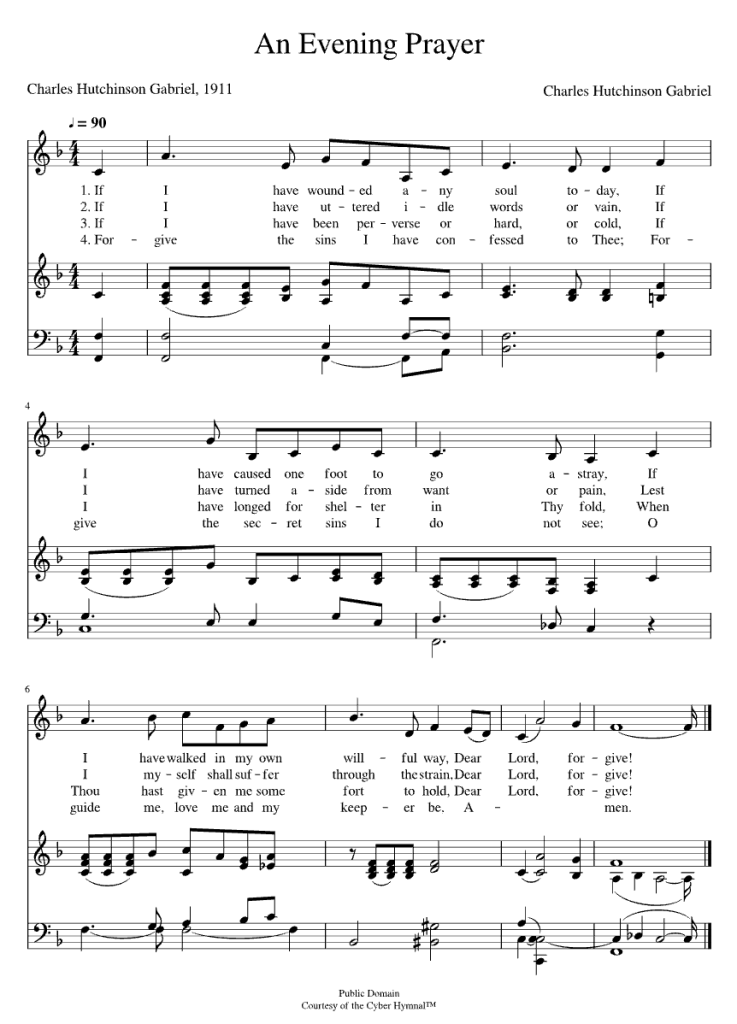
  • An Evening Prayer: A Heart Searching for God’s Forgiveness

    Some hymns are more than music—they are prayers set to melody. An Evening Prayer is one of these. Written with a spirit of humility, it leads us to reflect on the day that has passed and lay our failures before the Lord. Each verse is like a mirror, asking us to examine how we have spoken, acted, and even thought.

    The hymn reminds us that the Christian life is not measured only by great acts of faith but also by the quiet moments—whether we loved or withheld love, spoke with grace or carelessness, walked in God’s will or in our own. As we look at its verses, we discover a pattern of prayer that helps us seek both forgiveness and renewal.


    When We Hurt Others Unknowingly

    “If I have wounded any soul today,
    If I have caused one foot to go astray,
    If I have walked in my own willful way,
    Dear Lord, forgive!”

    We often think of sin in terms of great wrongs, but many of our failures are small words or actions that wound without us realizing it. A sharp comment, a neglect of kindness, or simply choosing our own way rather than God’s—these leave unseen scars.

    This verse reminds us to ask: Did my words help or harm today? Did my actions point someone closer to Christ, or did I nudge them farther away? The heart that prays this prayer shows humility, willing to confess even when it is not certain of every fault, because it longs to walk in God’s way rather than its own.


    Idle Words and Missed Compassion

    “If I have uttered idle words or vain,
    If I have turned aside from want or pain,
    Lest I myself shall suffer through the strain,
    Dear Lord, forgive!”

    How often do we waste our words on what is empty, careless, or unkind? Jesus Himself said, “But I tell you that for every careless word that people speak, they will give an account of it on the day of judgment” (Matthew 12:36, NASB). Idle speech may feel harmless, yet it reveals the state of our hearts.

    This verse also points us to the times we have ignored someone’s need. To turn aside from pain is to close our eyes to the very suffering Christ calls us to bear with others. Compassion requires more than sympathy—it calls for action. And when we turn away, not only does the other suffer, but our own hearts grow harder. In asking forgiveness, we ask God to soften us again, to make us attentive to His call to love.


    Coldness of Heart

    “If I have been perverse or hard, or cold,
    If I have longed for shelter in Thy fold,
    When Thou hast given me some fort to hold,
    Dear Lord, forgive!”

    This verse addresses the quiet sins of the heart—when we become stubborn, unyielding, or spiritually cold. Sometimes, even while enjoying the blessings of God’s care, we neglect the responsibilities He has entrusted to us.

    Jesus warned of this in His parable of the talents, where one servant hid what had been given to him rather than using it for his Master’s glory (Matthew 25:25, NASB). It is a sobering reminder: God has given each of us tasks to fulfill, people to serve, and opportunities to reflect His kingdom. To long only for shelter, while ignoring the fort He has placed in our hands, is to miss our calling.

    This stanza teaches us to confess not just our wrong actions but also our failures to be faithful stewards of what God has already given.


    The Seen and Unseen Sins

    “Forgive the sins I have confessed to Thee;
    Forgive the secret sins I do not see;
    O guide me, love me and my keeper be,
    Dear Lord, Amen.”

    The prayer ends with the most searching petition of all. We know some of our sins clearly—we confess them in detail. But there are others, hidden even from our own awareness. Pride we don’t recognize, selfishness we justify, attitudes we excuse. David prayed the same in Psalm 19:12: “Who can discern his errors? Acquit me of hidden faults” (NASB).

    This final verse teaches us a vital truth: forgiveness is not just about confession, but about trust. We entrust even the unknown corners of our hearts to God, asking Him to reveal, forgive, and cleanse us. And with forgiveness comes guidance. The prayer ends not only with “forgive,” but with “guide me, love me, and my keeper be.” True forgiveness always draws us closer to the Shepherd who both rescues and leads His sheep.


    Living the Evening Prayer

    An Evening Prayer is more than a hymn to close the day—it is a pattern for the Christian life. It calls us to:

    • Examine ourselves honestly in the light of God’s holiness.
    • Confess humbly, not only what we know but even what we cannot yet see.
    • Seek forgiveness freely, trusting in Christ’s sacrifice.
    • Ask for guidance, that tomorrow might be lived more faithfully.

    This hymn gathers the whole of Christian repentance into one prayer: our words, our actions, our hearts, and even our hidden faults. Each evening, it teaches us to bring all of these before the Lord who loves us. And in doing so, we find not only forgiveness but also renewal, rest, and the steady hand of the Shepherd guiding us into a new day.


  • If You Love Me, Keep My Commandments

    Love is one of the deepest forces in human experience, but when Scripture speaks of love, it takes us beyond anything ordinary. Biblical love is not casual or convenient; it is consuming. It does not simply touch the surface of our emotions—it shakes the very core of who we are. To love God is not to sprinkle affection on top of an otherwise unchanged life, but to yield ourselves fully to Him, heart, soul, mind, and strength. As Jesus said, “You shall love the Lord your God with all your heart and with all your soul and with all your mind” (Matthew 22:37).

    This love is never left vague in Scripture. It takes shape in real, practical ways. It confesses Christ openly, repents sincerely of sin, and submits in obedience. It is proven not in lip service but in wholehearted devotion. And it finds its truest example at the cross, where Christ loved with perfect obedience and total sacrifice.

    John reminds us, “In this is love, not that we have loved God but that he loved us and sent his Son to be the propitiation for our sins” (1 John 4:10). God loved us first—fully and undeservingly. The question is how we will love Him in return. Will it be with shallow words and reluctant obedience, or with the kind of love that mirrors Christ Himself?


    Love Beyond Lip Service

    It is possible to claim love for God while living in ways that deny Him. Jesus warned of this very danger: “This people honors me with their lips, but their heart is far from me” (Matthew 15:8). Words of devotion may sound convincing, but without a heart surrendered to God, they are hollow.

    Confession is certainly part of loving God. Scripture tells us, “If you confess with your mouth that Jesus is Lord and believe in your heart that God raised him from the dead, you will be saved” (Romans 10:9). Yet this confession is more than repeating a formula; it must be joined with genuine faith and a transformed life. The danger lies in confessing Christ with the lips while withholding the heart. Jesus Himself said, “Why do you call me ‘Lord, Lord,’ and not do what I tell you?” (Luke 6:46).

    True confession is not simply stating what we believe—it is declaring allegiance. It is saying, “Jesus is Lord,” and then living in a way that demonstrates He truly is Lord of our lives. When confession is real, it leads to surrender. When it is empty, it leaves us unchanged.

    The early church understood this well. Their confession of Christ often cost them friends, family, livelihood, and even life itself. To say “Jesus is Lord” meant Caesar was not. It meant obedience to Christ came before all else. Such confession was not lip service; it was a pledge of loyalty, sealed by their very lives.

    This is the kind of confession God desires from us—not words spoken lightly, but words that flow from faith, devotion, and obedience. Anything less is merely lip service, and lip service will not stand before the Lord who searches the heart.


    Obedience as the Test of Love

    Jesus tied love and obedience together in the clearest of terms: “If you love me, you will keep my commandments” (John 14:15). Love is not proven by words alone but by the willingness to listen and to do what He says. This is why John could later write, “For this is the love of God, that we keep his commandments. And his commandments are not burdensome” (1 John 5:3). Obedience is not the enemy of love; it is its very expression.

    But not all obedience is the same. Some obey reluctantly, doing just enough to quiet the conscience. This kind of obedience looks for loopholes, delays action, or treats God’s word as negotiable. It is obedience in form, but not in spirit. The prophet Isaiah described this problem long before Jesus’ day: “This people draw near with their mouth and honor me with their lips, while their hearts are far from me” (Isaiah 29:13).

    True obedience flows from the heart. It is the natural fruit of love, just as a healthy tree bears good fruit. Jesus said, “If you keep my commandments, you will abide in my love, just as I have kept my Father’s commandments and abide in his love” (John 15:10). His own life shows us that obedience is not lifeless duty but the pathway into deeper fellowship with God.

    When love is at the center, obedience shifts from drudgery to delight. The psalmist declared, “I delight to do your will, O my God; your law is within my heart” (Psalm 40:8). This is not the cry of someone checking boxes—it is the song of one whose heart beats in rhythm with God’s will. Obedience becomes not only what we do, but who we are.

    Lackluster obedience cannot sustain us, but love-fueled obedience transforms us. It teaches us to trust when we don’t see the outcome, to surrender when our will clashes with His, and to persevere when faith is costly. Jesus did not obey halfway, nor should we. If we truly love Him, our lives will testify through consistent, wholehearted submission to His word.


    The Cross as the Measure of Love

    If we want to know what love looks like, we must look to Calvary. The world defines love in many ways, but the cross gives us the clearest picture: “But God shows his love for us in that while we were still sinners, Christ died for us” (Romans 5:8). Jesus’ love was not selective, waiting until we were worthy. It was sacrificial, given when we were most unworthy.

    At the cross we see both love and obedience perfectly united. Jesus said, “For I have come down from heaven, not to do my own will but the will of him who sent me” (John 6:38). That obedience cost Him everything. He endured rejection, humiliation, and unimaginable suffering. Yet He remained faithful: “And being found in human form, he humbled himself by becoming obedient to the point of death, even death on a cross” (Philippians 2:8). His obedience was not halfway—it was to the fullest extent possible.

    This sacrificial love sets the standard for our response. We are not called to a faith of convenience, but to a love that mirrors Christ’s own. As John wrote, “By this we know love, that he laid down his life for us, and we ought to lay down our lives for the brothers” (1 John 3:16). The cross shows us that love is not primarily about emotion but about costly action.

    It also teaches us that obedience without love misses the heart, and love without obedience is incomplete. At Calvary, Jesus loved perfectly by obeying perfectly. He did not say He loved the Father and then refuse the cup of suffering. Instead, He prayed, “Nevertheless, not my will, but yours, be done” (Luke 22:42). That prayer captures the essence of biblical love—surrender to God’s will even when it demands sacrifice.

    When we look at the cross, we are not only reminded of how deeply we are loved but also how we are called to love in return. To love God is to take up our cross daily (Luke 9:23), following the path of self-denial and trust. It is to measure our devotion not by convenience, but by willingness to lay down everything for the One who laid down everything for us.


    Love that Confesses, Repents, and Follows

    Loving God is not vague or undefined. It is not left to whatever each person feels in their heart. God has shown us how love takes shape in practical ways—through confession, repentance, and faithful obedience.

    Confession is the starting point. Paul writes, “If you confess with your mouth that Jesus is Lord and believe in your heart that God raised him from the dead, you will be saved” (Romans 10:9). To confess Christ is to declare that He is Lord—not only with words, but with loyalty. It is to take our stand with Him publicly, even when the world rejects Him. Confession is both an admission of faith and an act of allegiance.

    Repentance naturally follows. Jesus declared, “Unless you repent, you will all likewise perish” (Luke 13:3). Repentance is more than sorrow; it is a change of mind that leads to a change of life. It is turning away from sin and toward God. A heart that loves Him cannot remain comfortable in rebellion against Him. Love grieves what grieves God, and it longs to walk in His ways.

    That repentance is sealed in baptism, where we are united with Christ. As Peter preached, “Repent and be baptized every one of you in the name of Jesus Christ for the forgiveness of your sins, and you will receive the gift of the Holy Spirit” (Acts 2:38). Baptism is not an empty ritual but a demonstration of love and surrender. It is the moment when faith is expressed in obedient trust, and God’s promise of forgiveness is received. Paul describes it this way: “We were buried therefore with him by baptism into death, in order that, just as Christ was raised from the dead by the glory of the Father, we too might walk in newness of life” (Romans 6:4).

    Love confesses, repents, and follows. Each step is a response to God’s love for us—a way of saying, not with lips only but with life, “I belong to Christ.”


    A Call to Wholehearted Love

    All of this leads to a simple but searching question: do we love God with all that we are? Jesus gave the greatest commandment: “You shall love the Lord your God with all your heart and with all your soul and with all your mind” (Matthew 22:37). God does not ask for half-hearted devotion or occasional attention. He calls for the whole of us—our thoughts, desires, choices, and strength.

    Anything less risks becoming an empty religion. We may say the right words, perform outward duties, or keep up appearances, but without wholehearted love, we miss the heart of the gospel. Paul warned of those who “have the appearance of godliness, but deny its power” (2 Timothy 3:5). A lackluster obedience and a divided heart leave us far from the God who calls us.

    But wholehearted love is life-giving. Jesus said, “I came that they may have life and have it abundantly” (John 10:10). When we surrender to Him in love, our obedience comes alive. Our worship becomes genuine. Our service becomes joyful. Love fills every command with meaning, because each act of obedience is no longer about earning God’s favor—it is about responding to the love we already have in Christ.

    To love God wholeheartedly is to reflect His own love poured out for us at the cross. It is to let that love guide our words, shape our actions, and fuel our perseverance. Such love will not be content with bare-minimum obedience. It will be willing to sacrifice, to serve, and to endure. And in living this way, we shine as witnesses to the One who gave everything for us.


  • Jesus Paid It All

    Tonight as I listened to the old hymn “Jesus Paid It All,” I was reminded of the depth of God’s love and the completeness of Christ’s sacrifice. The words of this song are not just poetry—they are truth grounded in Scripture. Each verse calls us to remember what Christ has done, how it transforms our lives, and how it offers hope to the entire world.


    The Debt of Sin

    The hymn begins:

    “Gone is all my debt of sin,
    A great change is wrought within,
    And to live I now begin,
    Risen from the fall.”

    Every person stands guilty before God because of sin. Romans 3:23 says, “for all have sinned and fall short of the glory of God.” This is not a light burden—it is a debt that demands payment. Scripture tells us the cost: “For the wages of sin is death, but the gracious gift of God is eternal life in Christ Jesus our Lord” (Romans 6:23). Left on our own, we could only expect judgment.

    But Christ did what we could not. Colossians 2:13–14 says, “And when you were dead in your wrongdoings and the uncircumcision of your flesh, He made you alive together with Him, having forgiven us all our wrongdoings, having canceled the certificate of debt consisting of decrees against us, which was hostile to us; and He has taken it out of the way, having nailed it to the cross.”

    That is the hymn’s refrain: “And the debt, the debt is canceled, Jesus paid it, paid it all.” We do not stand before God as debtors anymore—we stand forgiven, free, and alive because of the cross.


    A Life of Gratitude

    The second verse shifts our attention from forgiveness to the new life it produces:

    “Oh, I hope to please Him now,
    Light of joy is on my brow,
    As at His dear feet I bow,
    Safe within His love.”

    When we truly grasp the sacrifice of Jesus, our hearts are moved to gratitude. Forgiveness is not simply a “clean slate” so we can live however we choose. Instead, it is the beginning of a new life devoted to the One who rescued us.

    Paul reminds us in 2 Corinthians 5:14–15, “For the love of Christ controls us, having concluded this, that one died for all, therefore all died; and He died for all, so that those who live would no longer live for themselves, but for Him who died and rose on their behalf.”

    Living in gratitude means every choice we make is shaped by Christ’s love. Our words, our actions, and our priorities all reflect a heart that longs to please Him. As Romans 12:1 urges, “Therefore I urge you, brothers and sisters, by the mercies of God, to present your bodies as a living and holy sacrifice, acceptable to God, which is your spiritual service of worship.”

    The “light of joy” on the brow, as the hymn says, comes from knowing that we are safe in His love. We no longer live under condemnation—we live under grace (Romans 8:1). And that grace fuels a joyful life of obedience.


    An Invitation for All

    The third verse of the hymn broadens the focus outward:

    “Sinner, not for me alone
    Did the Son of God atone;
    Your debt, too, He made His own,
    On the cruel tree.”

    The cross is not just my story—it is the story of the whole world. John 3:16 declares, “For God so loved the world, that He gave His only Son, so that everyone who believes in Him will not perish, but have eternal life.”

    Christ’s sacrifice is sufficient for all, though it must be accepted personally through faith and obedience. Hebrews 2:9 explains, “But we do see Him who was made for a little while lower than the angels, namely, Jesus, because of His suffering death crowned with glory and honor, so that by the grace of God He might taste death for everyone.”

    But obedience to the gospel is not simply a matter of believing—it requires a response of repentance and baptism. On the day of Pentecost, when the people were convicted of their sin, they asked Peter and the apostles, “Brothers, what are we to do?” Peter answered clearly in Acts 2:38: “Repent, and each of you be baptized in the name of Jesus Christ for the forgiveness of your sins; and you will receive the gift of the Holy Spirit.”

    Repentance means turning away from sin and turning toward God. Baptism is the point where our sins are washed away and we are united with Christ. Acts 22:16 records the words spoken to Saul of Tarsus: “And now why do you delay? Get up and be baptized, and wash away your sins by calling on His name.”

    Paul explains the meaning of baptism in Romans 6:3–4: “Or do you not know that all of us who have been baptized into Christ Jesus have been baptized into His death? Therefore we have been buried with Him through baptism into death, so that, just as Christ was raised from the dead through the glory of the Father, so we too may walk in newness of life.”

    The gospel is not meant to be kept to ourselves. If Jesus paid it all, then it is our joy to tell the world that through faith, repentance, and baptism, their debt too can be forgiven.


    Remembering and Longing

    The refrain brings us back again and again to the cross:

    “Jesus died and paid it all, yes,
    On the cross of Calvary, Oh
    And my stony heart was melted
    At His dying, dying call.”

    The cross softens even the hardest heart. Ezekiel 36:26 foretold this transformation: “Moreover, I will give you a new heart and put a new spirit within you; and I will remove the heart of stone from your flesh and give you a heart of flesh.” When we remember Calvary, we are moved to love, obedience, and hope.

    The hymn also reminds us that Christ’s shame and suffering were not meaningless—they were endured for us: “Oh, His heart in shame was broken / On the tree for you and me.” Hebrews 12:2 urges us to keep our eyes on this truth: “Looking only at Jesus, the originator and perfecter of the faith, who for the joy set before Him endured the cross, despising the shame, and has sat down at the right hand of the throne of God.”

    Remembering leads to longing. If Jesus gave everything for us, how can we not want to be with Him? Philippians 1:23–24 captures Paul’s own longing: “But I am hard-pressed from both directions, having the desire to depart and be with Christ, for that is very much better; yet to remain on the flesh is more necessary for your sakes.” We live faithfully here, but our hearts long for the day when faith becomes sight and we are forever in His presence.


    Conclusion

    “Jesus Paid It All” is not just a song—it is a confession of faith, a reminder of grace, an invitation to the lost, and a call to live in gratitude. May we let its message sink deep into our hearts:

    • Our debt is paid in full.
    • Our lives belong to the Savior.
    • Our mission is to share the good news.
    • Our hope is to be with Him forever.

    Truly, Jesus paid it all.


  • The Three Witnesses: Testimony That Demands a Verdict

    The Power of Testimony

    In a courtroom, a case can hinge on a single witness. But when three distinct and reliable witnesses give the same testimony, the evidence becomes undeniable. In the gospel of 1 John, the apostle doesn’t just appeal to feelings, opinions, or speculation—he anchors the truth of Jesus Christ in the testimony of three divine witnesses: the Father, the Word, and the Holy Spirit.

    “For there are three that bear witness in heaven: the Father, the Word, and the Holy Spirit; and these three are one” (1 John 5:7, NKJV).

    This is no vague mysticism. It’s a grounded, bold, historical declaration: that Jesus is the Son of God, and His life, death, and resurrection are irrefutably supported by Heaven’s own testimony.

    These three witnesses—Father, Word, and Holy Spirit—testify to the divine identity of Jesus. Their testimony is not symbolic or poetic—it is united and absolute. The Father affirmed the Son from heaven. The Word was made flesh and lived among us. The Spirit confirms and empowers the truth of Christ to this day. They speak to who Jesus is, what He has done, and what He still does for us now. If we listen carefully, they will call us not just to believe, but to respond.

    I. The Witness of the Father: The Voice from Heaven

    At the baptism of Jesus, the Father’s voice thundered from the heavens: “This is My beloved Son, in whom I am well pleased” (Matthew 3:17, NKJV). This was not only an announcement—it was a declaration of divine identity. God the Father affirmed Jesus publicly, leaving no doubt as to His origin or mission.

    Throughout Jesus’ ministry, the Father’s witness remained clear. At the transfiguration, the voice came again: “This is My beloved Son, in whom I am well pleased. Hear Him!” (Matthew 17:5, NKJV). The Father’s testimony is the first pillar of truth that demands our attention and submission. It affirms Jesus’ divine sonship and validates everything He said and did.

    And it calls us to follow Him. Jesus said, “Go therefore and make disciples of all the nations, baptizing them in the name of the Father and of the Son and of the Holy Spirit” (Matthew 28:19, NKJV). Baptism is not a mere ritual—it is a response to Christ’s authority and a union with His death, burial, and resurrection (Romans 6:3–4, NKJV).

    II. The Witness of the Word: The Life and Ministry of Christ

    The Word—Jesus Himself—is the living expression of God’s truth. “In the beginning was the Word, and the Word was with God, and the Word was God” (John 1:1, NKJV). The witness of the Word is not merely in teachings, but in the life Jesus lived, the compassion He showed, the miracles He performed, and the obedience He carried out unto death.

    Every word He spoke was truth. Every step He walked fulfilled prophecy. His crucifixion was not the end, but the fulfillment of God’s redemptive plan. As John wrote, “And the Word became flesh and dwelt among us” (John 1:14, NKJV). This witness reveals God’s heart in visible, human form.

    The Word testifies not just to who Jesus is—but to what He has done for us. His words confront us, comfort us, and ultimately call us to follow Him.

    III. The Witness of the Holy Spirit: The Enduring Testimony

    When Jesus ascended, He did not leave us alone. He sent the Spirit—the Helper, the Advocate, the Truth-bearer.

    The Spirit testifies that Jesus is alive. “The Spirit Himself bears witness with our spirit that we are children of God” (Romans 8:16, NKJV). The Spirit convicts the world of sin, righteousness, and judgment (John 16:8, NKJV), and He confirms in the hearts of believers that the gospel is true.

    This witness is not just internal; it’s scriptural. The same Spirit that descended on Jesus at His baptism inspired the apostles to record and proclaim the truth. “However, when He, the Spirit of truth, has come, He will guide you into all truth” (John 16:13, NKJV).

    How does the Spirit bear this testimony? Through the apostles—whom He empowered to speak and write infallibly—and today through the Word they recorded. The Bible, inspired by the Holy Spirit (2 Timothy 3:16–17), is the enduring witness to Christ, preserving the Spirit’s testimony for every generation.

    To ignore the Spirit’s testimony is to reject God’s own voice.

    A Verdict That Demands Action

    Three witnesses. All in agreement. All pointing to the same truth: Jesus is the Christ, the Son of the living God. The Father declared it from heaven. The Word revealed it on earth. And the Holy Spirit confirms it by illuminating the truth of Scripture, convicting our hearts, and giving us assurance of salvation through the Word He inspired.

    So the question is not, “Is there enough proof?” The question is, “What will you do with it?”

    Will you believe what the Father has spoken? Will you follow what the Word has revealed? Will you listen to what the Spirit is saying?

    “These things I have written to you who believe in the name of the Son of God, that you may know that you have eternal life” (1 John 5:13, NKJV).

    The testimony is complete. The witnesses are divine. The verdict is yours.


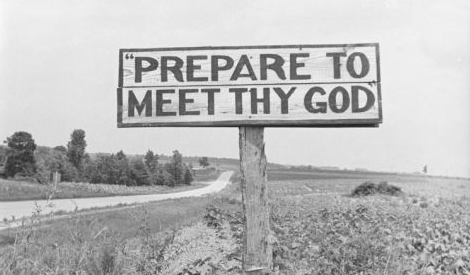
  • Prepare to Meet Thy God: The Urgency of a Life Examined

    The Message in the Storm

    When the clouds rolled in and the sky blackened over a small Oklahoma town, no one expected it to be the last moment some would ever see daylight. The sirens had wailed their warning, but not everyone had taken cover. A powerful tornado swept through the town, leaving ruin in its wake. Days later, a search team uncovered a heartbreaking scene: a father and daughter huddled in a bathtub, Bible open between them, as if reading together one last time.

    They didn’t survive. But they died holding the truth.

    It’s a reminder that every path—whether high or low, public or private—leads to one destination: standing before God.

    What does it mean to be ready? The phrase “prepare to meet your God” isn’t just poetic—it carries the tone of a challenge. In Amos 4, God had warned, disciplined, and called His people to return, but they refused. So He declared, “Prepare to meet your God.” It’s as though the Lord, the commander of heaven’s armies, is stepping onto the battlefield to confront rebellion face to face. Amos 4:13 reminds us who this God is: “For behold, He who forms mountains and creates the wind, and declares to mankind what are His thoughts… the Lord God of armies is His name” (NASB). This is not a warning to brush aside. It is a call to stand before a holy God—ready or not.

    “Prepare to meet your God” (Amos 4:12, NASB). That verse, written to a rebellious Israel, still speaks today. The prophet wasn’t issuing a suggestion—he was delivering a warning. And not just any warning—a final one. God had already sent famine, drought, plague, and war. Still, they would not return to Him. So He declared through His prophet, “Prepare to meet your God” (Amos 4:12, NASB).

    This is not a verse about doom; it is a verse about urgency. It is about being honest with your life and ready for your death.

    I. A People Unprepared

    Israel had seen God’s patience. They had also seen His discipline. But instead of turning back, they ignored Him. “Yet you have not returned to Me,” God repeated (Amos 4:6–11, NASB). It wasn’t that they didn’t know who God was—it’s that they stopped caring.

    We’re not so different. We make plans. We stay busy. We assume there will be time. But one day, time runs out.

    Jesus told a parable about a rich man who stored up possessions and told himself to relax, eat, drink, and be merry. But God said, “You fool! This very night your soul is demanded of you” (Luke 12:20, NASB).

    It’s possible to have everything but the one thing that matters. It’s possible to know about God and still not be ready to meet Him.

    II. A Warning with Purpose

    God doesn’t warn us because He enjoys seeing people afraid. He warns us because He wants to save us. Even His judgments are invitations to return. In Amos, God sent hardships “yet you have not returned to Me.” Every plague was a plea. Every drought a call.

    Hebrews 12:6 says, “For whom the Lord loves He disciplines” (NASB). God’s warnings are not punishment alone—they are opportunities. Opportunities to change, to wake up, to repent.

    The story of the prodigal son is a reminder of this. When the son hit rock bottom, “he came to his senses” (Luke 15:17, NASB). God is always waiting for us to do the same. But He won’t wait forever.

    III. The God We Will Meet

    When God said, “Prepare to meet your God,” He wasn’t just warning them of destruction. He was reminding them who He is. Amos 4:13 says, “For behold, He who forms mountains and creates the wind… the Lord God of armies is His name” (NASB).

    You won’t be meeting a distant deity. You’ll be meeting your Creator. The One who gave you life. The One who knows your every thought. The One who sent His Son to die for you.

    We will meet Him. “For we must all appear before the judgment seat of Christ” (2 Corinthians 5:10, NASB). That’s not a maybe. That’s a certainty. You won’t send someone else in your place. You won’t reschedule. You won’t delay.

    You will meet your God.

    IV. Preparing While You Can

    The tornado didn’t ask permission. Neither will death. That’s why preparation matters.

    We prepare not by living perfect lives but by submitting to a perfect Savior. We obey the gospel. We put on Christ in baptism (Galatians 3:27). We walk in the light (1 John 1:7). We confess our sins. We grow in grace. We stay watchful.

    Jesus said, “Be ready, because the Son of Man is coming at an hour you do not think He will” (Matthew 24:44, NASB).

    It’s not enough to know we need to prepare. We have to do it.

    Conclusion: No Regrets, Only Readiness

    One day, you will meet your God.

    You won’t need your bank account, your trophies, or your résumé. You’ll need your soul to be right with Him.

    Will you be like the five wise virgins who were ready when the bridegroom came—or like the five foolish ones who were shut out (Matthew 25:10–12)?

    That father and daughter in Oklahoma didn’t survive the storm—but they died holding onto hope. They met God with His Word in their hands.

    May the same be said of us.

    “Prepare to meet your God” (Amos 4:12, NASB). Not tomorrow. Not later. Now.


  • The Voice of Jesus: Are We Listening?

    When Jesus Speaks

    In a world filled with noise, the voice of Jesus can be drowned out by distraction, doubt, and the daily demands of life. Yet His voice is not silent. Jesus speaks—not just through His words in Scripture, but in the life He lived, the truth He taught, and the salvation He offers.

    In John 10:27, Jesus said, “My sheep listen to My voice, and I know them, and they follow Me” (NASB). This verse is more than poetic—it’s deeply personal. Jesus knows His followers, and they know Him. They recognize His voice because they have spent time with Him. They follow Him because they trust Him.

    The question is not whether Jesus is speaking—but whether we are truly listening. Are we tuning our hearts to hear Him? Or are we so busy, so distracted, so consumed with other voices that we miss His?

    Let’s take a closer look at what it means to truly hear the voice of Jesus and how listening to Him changes everything.

    I. His Voice Speaks with Authority

    Jesus wasn’t just another teacher. He spoke with the authority of heaven itself. In Matthew 7:29, we read, “He was teaching them as one who had authority, and not as their scribes” (NASB). The people were astonished—not just at what He said, but at how He said it. He didn’t quote others to back up His message. He was the message.

    Jesus’ words have the power to create, convict, and transform. He calmed storms with His voice. He cast out demons with a word. He forgave sins and healed diseases. When Jesus speaks, things happen. The question is—do we treat His words that way? Or do we treat them like optional advice?

    John 14:6 reminds us, “I am the way, and the truth, and the life; no one comes to the Father except through Me” (NASB). Jesus doesn’t just offer good ideas. He is the truth. When He speaks, heaven listens. So should we.

    II. His Voice Calls Us to Follow

    Jesus doesn’t just talk to be heard. He speaks so that we will follow. “Come, follow Me,” He said (Matthew 4:19). He didn’t hand out a list of rules first. He invited people to walk with Him. That same invitation is open today.

    But following Jesus means change. It means leaving behind our sin, our pride, and our comfort zones. It means trusting His way more than our own. Luke 6:46 hits hard: “Why do you call Me, ‘Lord, Lord,’ and do not do what I say?” (NASB).

    Listening isn’t just about hearing the words. It’s about putting them into action. James 1:22 tells us, “But prove yourselves doers of the word, and not just hearers who deceive themselves” (NASB). When Jesus calls, He expects a response—a life that reflects His leadership.

    III. His Voice Offers Comfort and Hope

    Jesus speaks not only with power but with deep compassion. He knows our struggles. He understands our pain. In Matthew 11:28, He says, “Come to Me, all who are weary and burdened, and I will give you rest” (NASB). These aren’t just nice words. They are a lifeline to the broken and the burdened.

    Jesus never turned away the hurting. He wept at graves, healed the sick, and welcomed the outcast. He still does. His voice is not cold or distant—it’s warm, personal, and full of grace.

    In John 14:27, He promises, “Peace I leave you, My peace I give you; not as the world gives, do I give to you. Do not let your hearts be troubled, nor fearful” (NASB). The peace Jesus gives is not empty comfort—it’s real and lasting.

    When anxiety rises, when hope feels far, Jesus still speaks: “I am with you.” But are we quiet enough to hear Him?

    IV. His Voice Warns with Love

    It’s easy to hear the comforting parts of Jesus’ voice, but He also speaks warnings—and not out of anger, but out of love. Just like a parent warns a child about danger, Jesus warns us about sin and its consequences.

    In Matthew 7:13-14, Jesus says, “Enter through the narrow gate… for the gate is wide and the way is broad that leads to destruction… the gate is narrow and the way is constricted that leads to life” (NASB). This is a wake-up call. Not everyone who hears about Jesus is on the right path. We must choose.

    Jesus doesn’t sugarcoat the truth. He warns us about false teachers, lukewarm faith, and the dangers of ignoring His word. Revelation 3:20 reminds us, “Behold, I stand at the door and knock” (NASB). But if we don’t open the door—if we ignore His warnings—we risk missing out on the life He offers.

    V. His Voice Must Be Heard Today

    Some people think they’ll listen to Jesus later—when life slows down, when they’re older, when it’s more convenient. But Hebrews 3:15 says, “Today if you hear His voice, do not harden your hearts” (NASB). Today—not tomorrow—is the time to listen.

    The longer we wait, the harder it can become to respond. The heart that ignores Jesus grows dull. But those who listen find life. Romans 10:17 says, “So faith comes from hearing, and hearing by the word of Christ” (NASB). We can’t believe if we won’t listen.

    Jesus is speaking today—through His Word, through the gospel message, through the lives of those who follow Him. But His voice won’t always wait.

    Will you listen before it’s too late?

    Call to Action: Are We Listening?

    Jesus is speaking. He has always been speaking—to the crowds, to the sinners, to the hurting, and to us. But are we paying attention?

    He speaks with authority—do we respect His Word? He calls us to follow—do our lives show it? He offers comfort—do we run to Him when we’re weary? He gives warnings—do we take them seriously? He speaks now—are we listening while we still have time?

    Let’s not let the noise of life drown out the most important voice we will ever hear. Let’s be people who don’t just hear Jesus—we follow Him.

    “Today if you hear His voice, do not harden your hearts” (Hebrews 3:15, NASB).

    He’s calling. Are you listening?


  • What Jesus Desires for Us

    When we talk about what Jesus wants for us, we need to remember that His desires come from love—not selfishness or control. In John 15:9, Jesus says, “Just as the Father has loved Me, I also have loved you; remain in My love” (NASB). That’s not a temporary or shallow feeling. It’s a strong, lasting love that led Jesus to give His life for us. He wants us to stay close to Him, enjoy His grace, and build our lives on the truth found in His Word.

    Jesus isn’t far off. He came to earth to be close to us and show us how to live. His death on the cross shows how much He wants to save us. His rising from the grave shows how much He wants to give us victory. And His Word shows us what kind of lives He wants us to live.

    Let’s take a closer look at what Jesus desires for each of us—and let’s ask ourselves: Do I want these things too?

    I. He Wants Us to Be Saved

    Jesus said, “For the Son of Man has come to seek and to save that which was lost” (Luke 19:10, NASB). Jesus came to rescue people. He didn’t come to point fingers—He came to bring us back to God. As John 3:17 says, “For God did not send the Son into the world to judge the world, but so that the world might be saved through Him.”

    God wants everyone to be saved. In 1 Timothy 2:4, Paul says God “desires all people to be saved and come to the knowledge of the truth.” That includes you. Jesus died for everyone, but not everyone will accept Him. He gives the invitation, but we must respond—by believing in Him, turning away from our sins, and being baptized (Acts 2:38).

    Jesus wants to save you. He left heaven for you. He gave His life for you. And He rose again for you. But He won’t force you—you have to choose Him.

    II. He Wants Us to Be Made Holy

    Jesus not only wants to save us—He wants to make us holy. That means He wants to clean up our hearts and help us live better. In John 17:17, Jesus prayed, “Sanctify them in the truth; Your word is truth” (NASB). To be sanctified means to be set apart for God and to live differently from the world.

    In 1 Thessalonians 4:3, Paul writes, “For this is the will of God, your sanctification; that is, that you abstain from sexual immorality.” God wants us to live clean, honest, and faithful lives. Being holy means we don’t just stop doing wrong—it also means we start doing what’s right. We grow a little more like Jesus every day.

    This isn’t always easy. It’s a daily journey. But Jesus wants our hearts to be pure—not just on the outside, but deep inside. He died not just to forgive our sins, but to help us overcome sin.

    III. He Wants Us to Be United

    Before Jesus went to the cross, He prayed that His followers would be united. He said, “I am not asking on behalf of these alone, but also for those who believe in Me through their word, that they may all be one” (John 17:20–21, NASB).

    Jesus doesn’t want His people to fight and divide. He wants us to be one—to love each other, to stand together, and to follow Him with one heart. In 1 Corinthians 1:10, Paul told the church, “Now I urge you… that you all agree and that there be no divisions among you.”

    We may have different backgrounds and opinions, but Jesus wants us to be united in truth and love. A united church shows the world what Jesus is like. A divided church only causes confusion. Jesus wants us to work together.

    IV. He Wants Us to Grow and Do Good

    Jesus wants our lives to show real change. In John 15:8 He said, “My Father is glorified by this, that you bear much fruit, and so prove to be My disciples” (NASB). Bearing fruit means showing the results of following Jesus.

    This includes our attitude and character—the fruit of the Spirit: “love, joy, peace, patience, kindness, goodness, faithfulness, gentleness, self-control” (Galatians 5:22–23, NASB). It also includes doing good works—helping others, teaching about Jesus, and living faithfully. Jesus said, “I chose you… that you would go and bear fruit” (John 15:16, NASB).

    We won’t be perfect. But we should be growing. Are we becoming more like Jesus? Are we doing things that help others see Him in us? Jesus wants us to grow and live in a way that honors Him.

    V. He Wants Us to Serve Others

    Jesus showed us what serving others looks like. He said, “For even the Son of Man did not come to be served, but to serve, and to give His life as a ransom for many” (Mark 10:45, NASB). Jesus helped people, healed people, and even washed His disciples’ feet.

    He wants us to have the same attitude. Philippians 2:5 says, “Have this attitude in yourselves which was also in Christ Jesus” (NASB). That means we don’t live just for ourselves—we live to help others.

    We serve not because we have to, but because we love Jesus. Galatians 5:13 says, “Through love serve one another.” Service is how we show love. Even small acts of kindness matter when they come from a heart that follows Jesus.

    Conclusion: Do I Want What Jesus Wants?

    Jesus has made it clear what He wants for our lives. He wants us to be saved. He wants us to live holy lives. He wants us to be united with other believers. He wants us to grow and do good. And He wants us to serve others with love.

    These things aren’t meant to weigh us down—they’re meant to lift us up. When we live this way, we find joy, purpose, and peace. Psalm 37:4 says, “Delight yourself in the Lord; and He will give you the desires of your heart” (NASB). When we want what Jesus wants, we find what truly matters.

    So here’s the question: Do I want what Jesus wants for me? Or am I holding back? Jesus is waiting for us to respond. He’s calling each of us to follow Him—not just in word, but in life.

    Let’s say yes. Let’s live the kind of life Jesus wants for us. And let’s show the world what it means to truly follow Him.